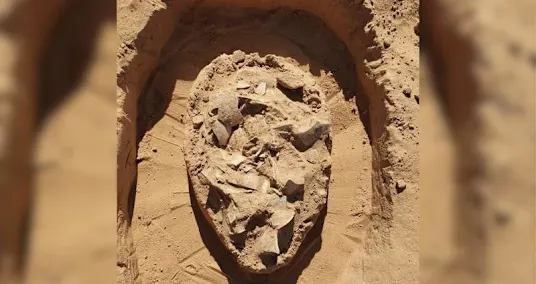
The eggs were discovered near the remains of a campfire believed to have been connected to prehistoric desert nomads who collected, cooked, and ate the eggs at the site.
A cache of ostrich eggs dated from approximately 7,000-years-ago was discovered at an archaeological site near Nitzana in southern Israel, the Israel Antiquities Authority (IAA) said in a Sunday social media post.
The eggs were discovered near the remains of a campfire believed to have been used by prehistoric desert nomads who collected, cooked, and ate them at the site.
"The proximity of the eggs to the fire and the manner in which they were found indicate that this was not a natural dispersal, but a deliberate collection," IAA archaeologist and researcher of nomadic cultures in the Negev and Arava Lauren Davis said. "One of the eggs was found right inside the hearth of the fire, a fact that strengthens the idea that they were used for food.”
Davis explained that these types of sites are often quickly covered by dunes and then exposed again over thousands of years as the sands shift in the wind.
"Sites of this type are quickly covered by dunes, and are exposed as the sands move over hundreds and thousands of years. This fact allowed for the exceptional preservation of the eggs, which are usually not preserved. Fortunately, the excavation provided us with a glimpse into the lives of the nomads who roamed here at that time."

Other finds discovered in Nitzana area
Earlier this month, archaeologists from Ben-Gurion University of the Negev (BGU) discovered a 1,400-year-old church at Nitzana National Park on the Israel-Egypt border, dating to the Byzantine and Early Islamic periods (fifth to seventh century CE).
The church, located on the main road leading to Saint Catherine Monastery and Mount Sinai, is the sixth to be discovered at the site and served both residents of the ancient city of Nessana (Nitzana) as well as pilgrims arriving in the area.
Archaeologists also uncovered a large hospice and bathhouse complex, complete with marble-clad tubs, and several preserved mosaics were also found at the site.
LATEST POSTS
- 1
 How did life begin on Earth? New experiments support 'RNA world' hypothesis
- 2Vote in favor of Your #1 4K television: Lucidity and Drenching Matter
- 3Mali and Canadian miner Barrick agree to resolve tax dispute, ending 2-year standoff
- 4Mysterious bright blue cosmic blasts triggered by black holes shredding stars, scientists say. 'It's definitely not just an exploding star.'
- 5When darkness shines: How dark stars could illuminate the early universe


- 9 Under-The-Radar Malaysian Islands To Consider Instead Of Thailand Or Indonesia
- Carina Nebula shines with white-blue stars | Space photo of the day for Jan. 5, 2026
- This Week In Space podcast: Episode 203 — China Rising
- Concern for couple jailed in Tehran as British embassy closes
- New peace laureate: Iran's arrest of Mohammadi 'confession of fear'
- Earth’s magnetic field protects life on Earth from radiation, but it can move, and the magnetic poles can even flip
- NASA's make-or-break moon shot
- Tehran synagogue damaged by missile strike according to Iranian media
- Material of Innovativeness: A Survey of \Releasing Your Imaginative Potential\ Online Workmanship Course