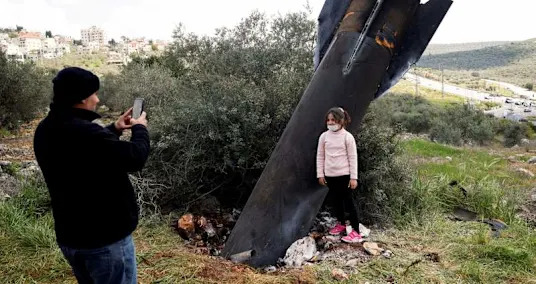
Iran has launched hundreds of missiles towards Israel since the start of the war, fragments of which are four to five meters long and have landed in school playgrounds.
Some are the size of small trucks, and they've come crashing to the ground almost daily for a month - littering school yards, roadsides, and hilltops with visceral remnants of a Middle East at war.
Across Israel and the West Bank, massive chunks of Iranian ballistic missiles have slammed to the earth after being shot out of the sky by Israeli air defense systems.
Near the West Bank city of Nablus, a young girl posed with a missile fragment that smashed into an olive tree grove. In a school in the West Bank, children climbed on a huge metal missile case that fell in their playground.
Nearly a month after Israel and the US launched their joint war with Iran, Israelis and Palestinians have become used to frequent official warnings to stay away from missile fragments, which could contain unexploded ordnance or toxic materials.
"These objects may appear harmless at first glance, but can pose a risk of explosion and shrapnel," Israel's national ambulance service said on Friday.

Missile fragments fall in West Bank towns
At least 270 missile fragments have fallen across the West Bank, the majority near Ramallah, with others landing near Nablus, Bethlehem, Hebron, and Salfit, according to figures issued by the Palestinian Authority's civil defense.
It cooperates with police to move missile fragments to secure locations, said civil defense spokesperson Nael Azza. At least three Palestinians had been arrested for trying to sell off missile fragments as scrap metal, he said.
Since the beginning of the war, movement restrictions combined with a spike in Israeli settler violence have delayed emergency response efforts in the West Bank, Azza said.
Lahjat Hamaj, 59, a resident of the Palestinian village of Beitin near Ramallah, where a missile fragment had fallen recently, said that it took about two hours for emergency response teams to reach them.
"When this missile (fragment) fell, the sound was strong across the whole town," said Hamaj.
Israel says its West Bank restrictions since the start of the war are aimed at reducing threats to troops deployed in the area.
Fragments up to five meters long
Iran has launched hundreds of missiles towards Israel since the start of the war, during which the US and Israel have bombed thousands of targets in Iran.

When they are shot down by Israel's missile defense system, which authorities say has a 90% interception rate, shrapnel and missile fragments often fall to the ground - causing damage, injury, and sometimes death.
Missiles launched from Iran and Lebanon towards Israel have killed 22 people in Israel, according to Israel's ambulance service, including four Palestinian women who were killed in the West Bank as a result of missile attacks.
Some of the Iranian fragments that fall to the ground are four to five meters long. Such fragments are likely from Iranian Ghadr or Emad ballistic missiles, an Israeli military official said.
LATEST POSTS
- 1
 What loving-kindness meditation is and how to practice it in the new year
 - 2Home Machine Basics: An Exhaustive Purchasing Guide
- 3Launch pad damaged as Russian rocket blasts off for space station, agency says
- 4'Not the moon that I'm used to seeing': Artemis II astronauts describe seeing the far side
- 5Europe picks companies to help build Argonaut moon lander




- Netanyahu vows to ‘return Negev to Israel,’ pledges settlement growth during visit
- Find Successful Magnificence Items for Sparkling Skin
- Changes to CDC website spark debate over autism and vaccine misinformation
- 80 km. on foot: Sharren Haskel’s three-day march in protest of haredi draft bill
- Find the Insider facts of Compelling Systems administration: Building Associations for Progress
- FDA claims on COVID-19 vaccine safety are unsupported by reliable data – and could severely hinder vaccine access
- UN rights chief says Israeli policy in West Bank 'resembles apartheid system'
- Dominating Online Entertainment Showcasing: 7 Hints for Organizations
- Doggie diversity in size and shape began at least 11,000 years ago


