When you buy through links on our articles, Future and its syndication partners may earn a commission.

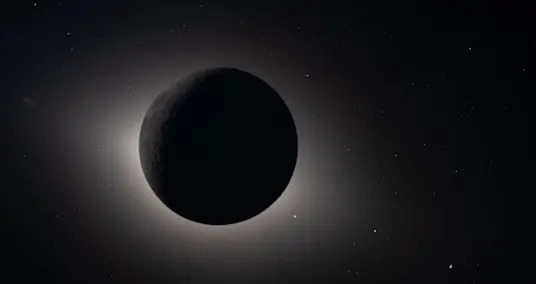
NASA's Artemis 2 astronauts have witnessed one of the rarest sights in spaceflight history — a total solar eclipse from beyond the moon.
The event unfolded yesterday (April 6) as the Orion spacecraft looped around the far side of the moon. This trajectory placed the crew in the right place at the right time to see the moon completely block the sun for about 53 minutes, which is far longer than the maximum period of totality for eclipses seen from Earth.
But it wasn't just the duration that made this eclipse extraordinary; it was the view.
NASA astronaut Victor Glover described the scene unfolding as the sun vanished behind the lunar disk.
"This continues to be unreal. The sun has gone behind the moon and the corona is still visible. It's bright and creates a halo almost around the entire moon," Glover said.
As darkness fell, another phenomenon quickly emerged. "When you get to the Earth side, the earthshine has already shown … almost seconds after the sun sets behind the moon, you can see earthshine," he added.
From Orion's windows, the crew was able to make out the faint glow of sunlight reflected off Earth, while stars and planets appeared in the background. The moon itself became a stark silhouette: "This black orb out in front of us," as Glover described it, edged by the glowing solar corona.

Though a rare sight, it's not the first time a solar eclipse has been viewed from lunar realms. The Apollo astronauts, who orbited the moon rather than flew by it (as Artemis 2 did), also saw solar eclipses, NASA's Kelsey Young, Artemis science flight operations lead, said during a press conference on Saturday (April 4).
The eclipse marks just one highlight in an already historic mission. Artemis 2 is the first crewed journey to the moon since Apollo 17 and has already set a new distance record for human spaceflight.
Following their impressive lunar flyby, the astronauts are now heading back toward Earth and are expected to splashdown on Friday (April 10) off the coast of San Diego.
LATEST POSTS
- 1
 Scientists are getting our robotic explorers ready to help send humans to Mars
- 2Kids get diseases like lupus, too. As researchers hunt better treatments, this camp brings joy
- 3The Most Well known Online Entertainment Forces to be reckoned with of 2023
- 4Burkina Faso forces killed twice as many civilians as jihadists, rights group says
- 5Etymological Investigation Disclosed: A Survey of \Dominating New Tongues\ Language Learning Application





- Geminid shooting stars: One of 2025's most exciting meteor showers begins tonight
- Interoceanic Train derails in southern Mexico, injuring at least 15 and halting traffic on line
- Best bar-b-que Style: Which One Is Your Number one?
- Woman charged in unprovoked stabbing of tourist changing baby's diaper in Macy’s Herald Square store
- Noctourism: the new safari travel trend that's changing the wildlife we can photograph in Africa
- Are IDF reservists properly armed during post-war operations?
- Remain Fit: Powerful Wellness and Work-out Schedules for a Better You
- Eleven arrested over mass shooting in South Africa tavern
- Delta flight bound for Atlanta makes emergency landing after engine issue